
How to Build a Multilingual Content Strategy That Converts (Complete Guide for International Businesses)

Expanding into international markets is one of the most powerful ways to grow your business. But reaching a global audience is not just about translating your website into different languages.
To truly succeed, you need a multilingual content strategy that connects with local audiences, ranks in search engines and drives real conversions. When done right, multilingual content does more than increase visibility. It builds trust, improves engagement and turns visitors into customers across different regions.
So how do you build a multilingual content strategy that actually converts?
What Is a Multilingual Content Strategy?
A multilingual content strategy is a structured approach to creating, translating and optimising content for different languages and markets.
It goes beyond translation. It involves:
Localising content for cultural relevance
Optimising for local SEO and search behaviour
Aligning messaging with audience expectations
Maintaining a consistent brand voice globally
The goal is simple. Deliver the right message to the right audience in the right language and format.
Why Multilingual Content Matters for SEO and Conversions
If you want to reach international customers, your content needs to be visible in local search results. Search engines like Google rank content based on relevance, language and user intent. That means directly translated content often underperforms because it does not match how users actually search.
For example, a keyword that performs well in English may not exist in the same form in another language. If you rely on direct translation, you risk missing valuable search traffic.
At the same time, users are far more likely to trust and engage with content that feels natural and local. This directly impacts:
Click-through rates
Time on page
Conversion rates
In short, better localisation leads to better results.
10 Steps to Build a Multilingual Content Strategy That Converts
Building a high-performing multilingual content strategy requires a structured, data-driven approach. The steps below will help you improve international SEO, connect with local audiences and increase conversions across global markets.
Step 1: Define Your Goals and Target Markets
Start with clarity.
Ask yourself:
Which countries or regions are you targeting?
What outcomes do you want to achieve?
Which products or services are most relevant to each market?
Not all markets should be treated the same. Some may require more content, different messaging or a unique approach.
For example, expanding into Germany may require more formal, detailed content, while other markets may respond better to a more conversational tone.
Clear goals help you prioritise and allocate resources effectively.
Step 2: Conduct Local Keyword Research
This is one of the most important steps in building a multilingual SEO strategy. Instead of translating your English keywords, research what users actually search for in each language.
For instance, a UK user might search for “affordable winter sweaters,” while in another market, users might search for a phrase closer to “cheap wool jumpers” or focus on material rather than price.
Key actions:
Use local keyword research tools
Analyse competitors in each region
Identify the search intent behind queries
Focus on high-intent and conversion-driven keywords
This ensures your content is discoverable and relevant.
Step 3: Localise, Do Not Just Translate
Translation focuses on words. Localisation focuses on meaning. To convert effectively, your content must feel like it was written specifically for the target audience.
This includes:
Adapting tone and style
Adjusting cultural references
Using appropriate examples
Aligning with local expectations
For instance, a call to action like “Get in touch today” may need to be more formal or more direct depending on the market.
Localisation makes your content feel authentic, which builds trust.
Step 4: Map Content to the Customer Journey
A high-performing multilingual strategy supports users at every stage of the journey.
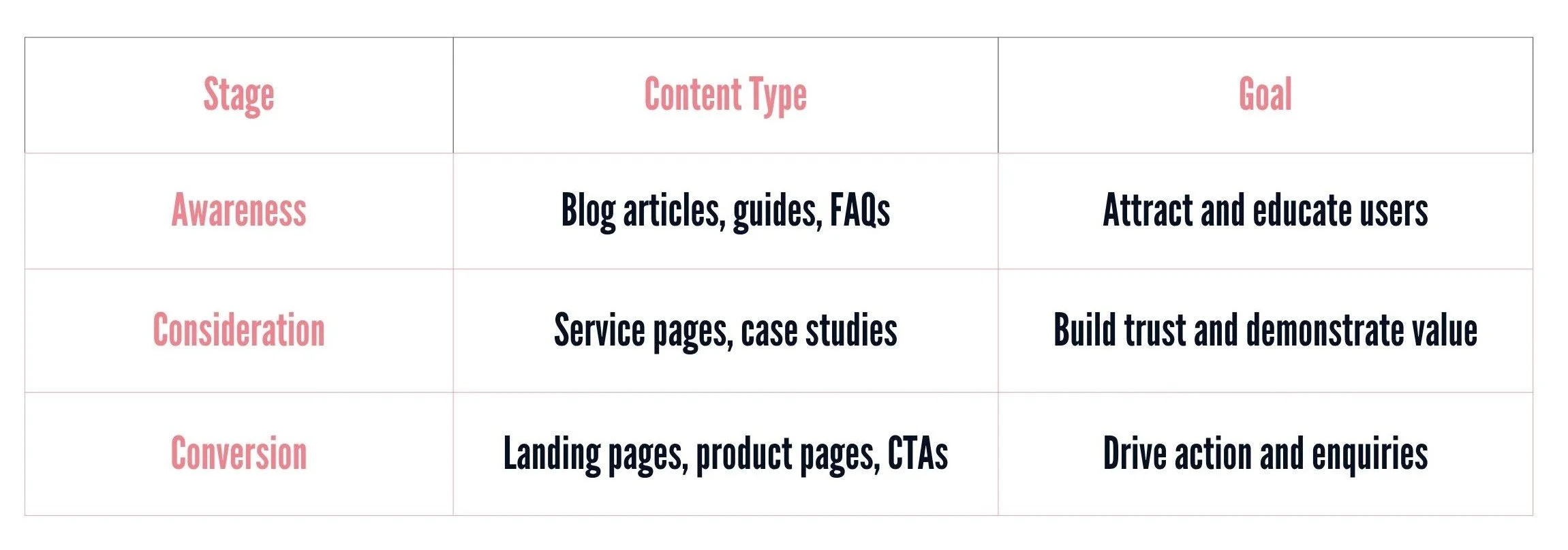
Each piece of content should guide the user naturally towards the next step. If you only translate sales pages, you miss the opportunity to attract and nurture your audience earlier in the journey.
Step 5: Maintain Brand Consistency Across Languages
Your brand should feel consistent, no matter the language.
This means:
Using a clear tone of voice
Keeping messaging aligned
Maintaining consistent terminology
Creating a multilingual style guide or glossary can help ensure consistency across all content. Without this, your brand may feel fragmented, which can reduce trust and credibility.
Step 6: Combine AI Efficiency with Human Expertise
AI translation tools can significantly speed up content production. They are especially useful for large-scale projects.
However, relying on AI alone is risky.
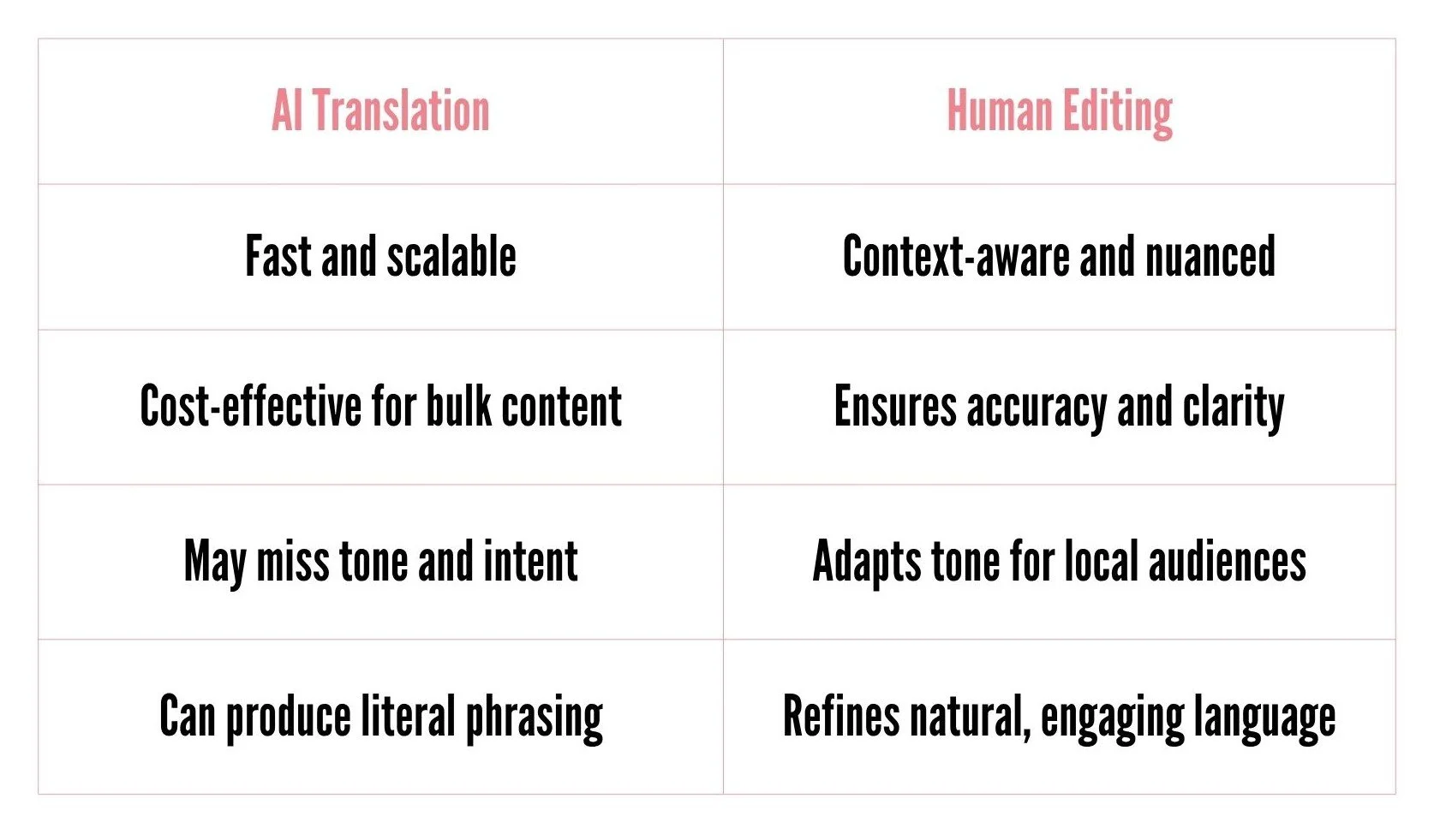
AI may misinterpret context, miss cultural nuances or produce unnatural phrasing. Human editors refine the content by improving clarity, adapting tone and ensuring consistency. The most effective strategy combines both. AI for speed, humans for quality.
Step 7: Optimise Technical SEO for Multilingual Websites
Technical SEO plays a key role in how your content performs across different regions.
Key elements include:
Correct hreflang implementation to signal language and region
Clear URL structures for each language
Proper indexing of all language versions
Fast loading speeds globally
Without these, even well-written content may struggle to rank.
Step 8: Create a Seamless User Experience
User experience is a major factor in conversion.
Make sure:
Navigation is simple and intuitive
Language switching is easy to find
Layouts remain clean after translation
Content displays correctly on all devices
A smooth experience builds confidence and keeps users engaged.
Step 9: Measure Performance Across Markets
To improve your strategy, you need to track results.
Monitor:
Traffic by country and language
Keyword rankings in each market
Bounce rates and engagement metrics
Conversion rates and enquiries
If one language version underperforms, it may need better localisation, stronger messaging or improved SEO.
Step 10: Continuously Audit and Improve
A multilingual content strategy is not static. Search behaviour changes. Markets evolve. Your business grows.
Regular audits help you:
Identify gaps
Improve performance
Stay competitive
Turning Multilingual Content into Conversions
A successful multilingual content strategy is not just about being present in multiple languages. It is about performing in each one.
When your content is properly localised, optimised and aligned with user intent, it becomes a powerful tool for international growth. It helps you attract the right audience, build trust and convert visitors into customers across different markets.
Need Help Building a Multilingual Content Strategy That Converts?
If you are expanding internationally and want your content to truly deliver results, having the right support can make all the difference.
At Content Quality UK, we help businesses create and optimise multilingual content strategies tailored for global markets. From localisation and SEO to content audits and refinement, we ensure your content connects and converts.
Get in touch today, and let’s build a multilingual content strategy that helps your business grow internationally with confidence.
